A Study of the Grotesque: Forms of Life in the Chthulucene
12/27/2025 (Sat) - 2/14/2026 (Sat)
Yuyu Yang,Tu Wei-Cheng,Yao Jui-Chung,Hsiao Chu-Fang,Huang Hai-Hsin,Huang Chih-Cheng,Yen Yu-Ting,Wen Gum Gum,Weng Jhen-Ling
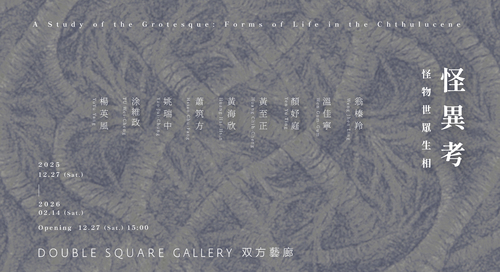
Double Square Gallery is honored to present another significant group exhibition of the year: A Study of the Grotesque: Forms of Life in the Chthulucene. Bringing together nine artists, this exhibition explores the deformation and alienation of material and biological bodies through painting and installation. It outlines a world that is non-static, heterogeneous, and interconnected, challenging the viewer’s existing cognitive frameworks.
The word "monster" derives from the Latin monstrare (to demonstrate) and monere (to warn), inherently possessing the qualities of display and admonition. In Chinese literature, much like the fox spirits and ghosts mirroring human society in Strange Tales from a Chinese Studio (Liaozhai Zhiyi), the "grotesque" (guài) often serves as a refraction of social reality and an alienation of human nature. The anomalies in Pu Songling’s writings question the so-called "ordinary" from a stance of abnormality on the boundary where humans and ghosts intermingle. Thus, the appearance of a monster depends on how society negotiates the boundary of "abnormality"; conversely, the existence of monsters forces society to define "normality." Society attempts to exclude monsters through boundaries, yet these very boundaries ultimately confine society itself.
The exhibition opens with variations of daily life. Huang Hai-Hsin extracts moments of humor and awkwardness, rendering contemporary society absurd; Hsiao Chu-Fang transforms limbs and faces with witty brushwork, exploring unique perceptions of life. The perspective then shifts to a deep gaze at the physical body: Yen Yu-Ting depicts flowing, intertwined bodies to metaphorize interpersonal anxiety; Wen Gum Gum transforms the spectacle of the female body, endowing it with new agency; Weng Jhen-Ling uses the texture of copper plate etching to carve out physical pain and alienation. Expanding to the boundaries of history and mythology, Huang Chih-Cheng combines gold foil with mixed media to navigate the line between the human and non-human; Yao Jui-Chung juxtaposes gold leaf and ink with cynicism, reconstructing the link between mythology and power; Tu Wei-Cheng expands fossil forms, responding to the future with a retrospective gaze; and Yuyu Yang reflects the relationship between the viewer and mythical creatures through refined lines and mirrored surfaces.
We invite the audience to revisit the concept of the "Chthulucene," coined by Donna Haraway in 2016 as a response to the Anthropocene. Unlike anthropocentrism, Haraway’s vision advocates for a world where the continuation of the human species is not the sole purpose. Instead, it seeks multi-species flourishing and the making of non-traditional, cross-species kin. This is also an exercise in the "metamorphosis" of human perception: we must learn to transform our perception into non-linear "Tentacular Thinking," probing and touching the world like countless feelers, rejecting a linear view of progress, and facing the complex issues of the contemporary environment and society within the entanglement.
As Lynn Margulis’s endosymbiotic theory has been substantiated, cross-species collaboration is now recognized as an intrinsic driving force of natural evolution. The contemporary perspective is no longer dominated solely by survival of the fittest, making the rejection of heterogeneity obsolete. Through the presentation of monsters and heterogeneity, this exhibition attempts to spark contemplation on how to live with the "other" in a fractured contemporary society. Amidst the clamor, through the dialogue of these artists’ shared vocabulary of deformation, monstrosity, and heterogeneity, a scroll of the Chthulucene’s myriad forms slowly unfolds.