The Morphology of Thought: Sculpture Group Exhibition
10/10 (Sat) - 12/5/2026 (Sat)
Ni Hsiang, Hung Sheng-Hsiung, Wu Wei-Ting, Chiu Chao-Tsai, Chiow Liang-Cherng, Lin Yu Sheng, Hsu Ting, Hsu Jui-Chien, Tsui Kuang-Yu, Agi Chen Yi-Chieh, Chan Shih-Tai, Tsai Zung-Lung
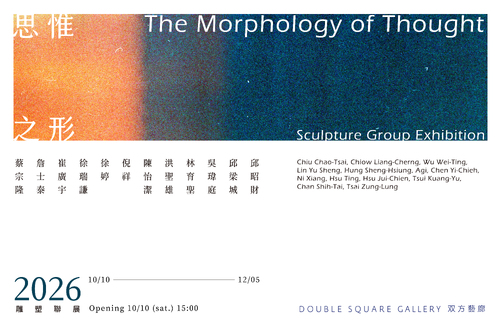
Double Square Gallery is pleased to present the contemporary sculpture group exhibition The Morphology of Thought from October 10 to December 5, 2026, featuring twelve active Taiwanese contemporary artists. Centered on "form," the exhibition looks beyond formal aesthetic styling to consider sculpture as physical manifestation and configuration arising from the collision and interplay between mind and matter. By focusing on a micro-scale dimension, the exhibition reveals how the artists, through acute perception and deliberate negotiation, establish clear, concrete boundaries for abstract thoughts within confined physical spaces.
Confronted with small-scale sculpture, viewers must abandon the habit of distant viewing, draw close, and read the density, shadows, and mechanical tensions of each object at intimate proximity. Several participating artists respond to the essence of materials through bodily labor, unearthing shapes latent beneath the surface: in recent years, Chan Shih-Tai has embraced a restrained gesture of "cleansing" that yields to the stone’s nature, retaining quarry fractures, textures, pencil marks, and chisel abrasions to reveal a warm human-stone dialogue within austere geometries; starting with ceramic sculpture and supported by metal, Chiow Liang-Cherng converts iron formwork into the tectonic basis of clay, shaping substantial, quasi-architectural volumes through manual incisions and unpredictable kiln fissures that condense the weight of time beneath subdued, dark glazes to yield a dynamic yet quiescent tension; Wu Wei-Ting captures a state of everyday psychological release within configurations of marble, composite materials, and light, revealing subtle gaps linked to daily life; Lin Yu Sheng repeatedly laminates thick acrylic paint strata before cutting and collaging them in an intricate process, deliberately deconstructing and reconstituting temporal axes to explore pigment’s potential as a sculptural medium.
"Form" also functions as the fixation of dynamic imagery. Hung Sheng-Hsiung's Stacking Shells series stems from the physical memory of crushing eggshells, capturing how membranes stretch, compress, and collapse between soft and rigid states before spraying layered real-stone sintering coatings to yield volcanic ash-like textures; Tsai Zung-Lung's Phototropism series arrests the moment seeds sprout, revealing interior spatial depths through structural fissures, while his Landscape series captures the creased shadows of crumpled paper in clay, translating them through fluid glazes into undulating valley topography.
Taking reflection on everyday experience as a departure point, the artists also translate "form" into mechanisms and interventions within daily life. Hsu Jui-Chien alters the standard reference points of everyday things, evoking latent consciousness beyond mass and movement as metal components and matter twist, grind, and reshape one another; Chiu Chao-Tsai integrates clockwork springs and mechanical interactions, relying on the viewer's active manipulation to disrupt stillness and construct a brief "toy condition" removed from reality through real-time kinematic feedback; Hsu Ting deconstructs, trims, and reconfigures images collected from everyday life, reorganizing space, light, and bodily perception across the gallery and frame to expand the dimensions through which images are viewed; Agi Chen Yi-Chieh shifts the collective visual memory of anime hues, solidifying flat character imagery into dynamic color blocks endowed with velocity; Ni Hsiang’s transformations of everyday ready-mades, alongside Tsui Kuang-Yu’s motorization of prosthetic hand models, puncture normative order with absurdity and wit, expanding the intersection between sculpture and conceptual performance.
Through a deliberate focus on micro-scale dimensions, The Morphology of Thought converts the gallery into a three-dimensional topology composed of diverse localized structures. Operating through their respective material logics and formal idioms, the twelve artists translate thought into objects with defined mass, gravity, and surface textures. The exhibition invites viewers to navigate among these independently realized micro-coordinates, tracing the formal dimensions established by thought in space through the sediment of stone and clay, photographic framing, and kinetic mechanisms.