War and Art: Shōnen and Shōjo
11/8 (Sat) - 12/13/2025 (Sat)
Chen Ching-Yao
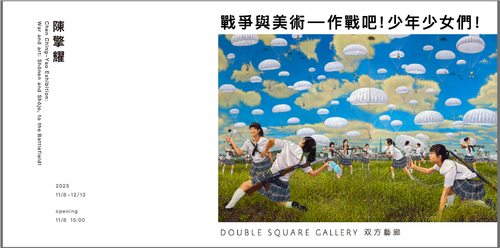
Double Square Gallery is honored to announce that it will exhibit the latest solo exhibition by artist Chen Ching-Yao, War and Art: Shōnen and Shōjo, to the Battlefield! , from November 8 to December 13, 2025. Following his highly-acclaimed exhibition, Chen Ching-Yao Exhibition: War and Art 84th Anniversary of the Outbreak of World War II, at the Tagawa Museum of Art in Fukuoka, Japan, the Taiwan presentation re-arranges and re-contexulalized the intricate, complex relationship between Taiwan and Japan—the colonized and the colonizer—during World War II in the Taiwanese context.
Chen Ching-Yao's work appropriates pop culture, political imagery, or artistic materials from Taiwan, Japan, and Korea, exploring the consciousness of power, leader worship, and collectivism hidden within, then deconstructing their authority through satirical adaptations.
This exhibition features Chen Ching-Yao's brand-new works sourced from WWII war paintings in both Taiwan and Japan. The realistic painting on a 300-F scale, Mortal Combat of a Unit on an East Asian Island, is adapted from Tsuguharu Fujita's 1943 war painting Mortal Combat of a Unit in New Guinea. Chen Ching-Yao replaces the tragic and brutal scene of the WWII front lines with a squad of girls carrying AK47s who perform it in a cheerfully playful manner. The work inherits the original composition’s magnificence and intense dramatic tension, but the abundant presence of high school girls’ accessories subtly hints at its contemporaneity. The "an East Asian Island" referenced in the work's title further alludes to the potential future crisis Taiwan may face.
In contrast, Taiwanese wartime paintings during WWII presented a slice of people’s life on the home front. In the two video works adapted from Chen Jing-Hui's Girls in Uniform and Tsai Yun-Yan's Boy's Day, female students chat about uniforms, and mothers and children contemplate the future; the helpless reality of being swept up by war and political situations is hidden within these ordinary daily dialogues.
The exhibition is also displayed alongside relevant Japanese artifacts from WWII, including painting catalogs, postcards, and the publication Shōnen Club (Boy’s Club), which had a profound influence on boys at the time, along with its complimentary military model kits. The visual narrative style of this publication also has a close heritage relationship with the Japanese pop culture and ACG aesthetics utilized in Chen Ching-Yao’s creations. Besides the boys, the exhibition also presents the multiple faces of women in war, such as female students, mothers, and the AK47 girl squad.
By juxtaposing artworks and historical artifacts, the exhibition guides viewers to consider the different perspectives that can be adopted when confronting past history. The 'battleground' mentioned in the title involves more than just the wartime boys and girls depicted in the artifacts and paintings. As curator Lai Pei-Chun states, the roles participating in this 'battleground' behind the scenes also include Chen Ching-Yao himself, the editors of Shōnen Club, and the war painters. Through the juxtaposition of artworks and artifacts, it becomes clearer how these "shōnen" constructed war imagery—both echoing and distinctly different—within the war narratives and painting styles of their respective eras.
Born in Taipei in 1976, Chen Ching-Yao received his MFA in Fine Arts from Taipei National University of the Arts in 2006. He has won the Award of Newly Emerging Artists in Taiwan and the First Prize of Taipei Arts Award. He was also the recipient of Asian Cultural Council's grant in 2009, which enabled him to conduct a residency in New York. In recent years, Chen's work centers around photography and painting. The range of his subject matter is very wide, and his work focuses on the deconstruction of power and symbols. He often appropriates symbols of popular culture, especially those of the Japanese and Korean pop culture, and even the portraits of Asian politicians, and
drastically recreates and transforms them into humorous, amusing images and behaviors, or simply assumes the roles of these figures himself in his work. By doing so, he creates a strong sense of contrast to the original subject and produces laughter. His downplaying the symbols of power is undoubtedly a sarcastic satire against modern society. While making his audience laugh about the situation, he also aims to make them reflect upon the absurdity of different actions of power in their surroundings.